Posterior Ankle Impingement in Dancers: Os Trigonum Pain Explained

Updated: Oct 7
A pinch at the back of your ankle when you point your foot. Discomfort that shows up in arabesque, relevance, or any time you push through full plantarflexion. Pain that rest calms and dance brings right back.
If this is familiar, posterior ankle impingement — sometimes involving a small bone called the os trigonum — may be what's driving it. The good news: it's usually very treatable without surgery, and most dancers can stay in the studio throughout the process.
What Is Posterior Ankle Impingement?
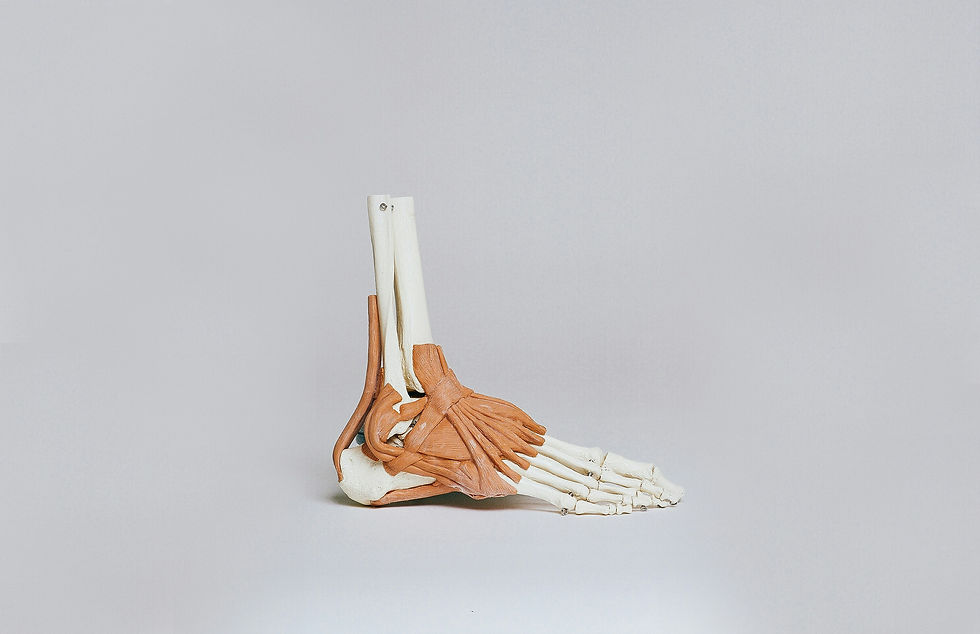
The posterior ankle contains soft tissue structures — the posterior capsule, the posterior talofibular ligament, the flexor hallucis longus tendon, and fatty tissue — that can become compressed during full plantarflexion (pointe). When any of these structures are irritated, compressed, or thickened, pushing through end-range plantarflexion produces pain.
In about 10% of people, there's also a small accessory bone at the posterior talus called the os trigonum. In most people it causes no problems. In dancers whose work repeatedly pushes into full plantarflexion, it can become a site of impingement — either by directly compressing soft tissue, or by fracturing ("os trigonum syndrome").
An os trigonum on imaging does not automatically mean surgery. In the majority of cases, conservative management with a skilled PT resolves symptoms and gets dancers back to full load.
Why It Keeps Coming Back
The most common reason posterior ankle impingement recurs is that the underlying drivers — the mechanical reasons why the posterior ankle is being overloaded — haven't been addressed.
Ankle plantarflexion range that exceeds what the surrounding structures can stabilize
Compensatory movement patterns in relevance or arabesque that increase posterior compression
Reduced calf and intrinsic foot strength that shifts load to passive posterior structures
Load spikes — sudden increases in relevance volume, pointe work, or jumping — that outpace tissue capacity
What Conservative Management Looks Like
Reduce the provocative load. In the acute phase, this usually means temporarily modifying relevance volume, pointe work, and jump landings — not stopping dance entirely. The goal is to bring load below the irritation threshold while building capacity.
Build calf and ankle strength. Progressive eccentric calf loading is one of the most evidence-supported interventions for posterior ankle issues. Building the capacity of the Achilles-calf complex reduces how much load the passive posterior structures have to absorb.
Address the full chain. Hip mechanics, knee alignment, and how a dancer enters and exits pointe all affect how the posterior ankle is loaded. A movement assessment that looks at how you actually dance is worth more than isolated ankle exercises.
Manual therapy. Soft tissue work to the posterior ankle structures and ankle joint mobilization can reduce irritation and improve range of motion in a way that passive stretching alone doesn't.
When to Consider Surgery
Surgery for os trigonum syndrome (removal of the bone fragment) is appropriate when conservative management has been thorough and genuinely unsuccessful over several months, or when imaging shows clear fracture with persistent instability. In my clinical experience, most dancers reach full return to dance without going that route — but when conservative care isn't enough, surgical outcomes for os trigonum excision are generally excellent.
Related Reading
Free Resource for Dancers
Download the free Dancer's Guide to Recurring Pain — covering ankle, hip, and low back pain patterns in dancers, with self-checks to help you identify what's happening before it becomes a bigger problem.
Work With a Dance-Informed PT
Posterior ankle impingement is one of the most common issues I treat in dancers — and one of the most satisfying, because conservative management is effective the majority of the time. At Flourish Physical Therapy in Bellevue, WA, every session is 1:1 with Dr. Kinsey Winter, PT, DPT, with an evaluation that looks at the full movement chain, not just the ankle.
📍 Bellevue, WA | Dance PT | 1:1 | Cash-pay | Accepting new patients


Comments